He was guessing what to post. Now he can see what works.
Davide Lucchini teaches people how to negotiate. He was making short videos with no way of telling which ones had worked, or why. We built him a tool that watches the videos already doing well in his field, works out what they get right, and turns that into scripts he can read straight to camera.
- What they do
- Coaching and training · Switzerland
- Built by
- Stivan, as CTO of Prisma Group
- Live since
- August 2026
- The deadline
- A webinar on 30 September, fixed
- Their site
- dlcoaching.ch
He was guessing, every single time.
Davide was not short of ideas. He was short of a way to tell which ones were worth filming. A video did well or it did not, and nobody could say why. So every new one started from a blank page and a hunch.
That made the output uneven. Some weeks he posted four videos, some weeks none, and the difference was simply how busy the week had been. You cannot build an audience on that.
And the clock was running. A webinar was booked for 30 September. Ads were booked for 15 September. For either to be worth anything, people had to already know who he was by then.
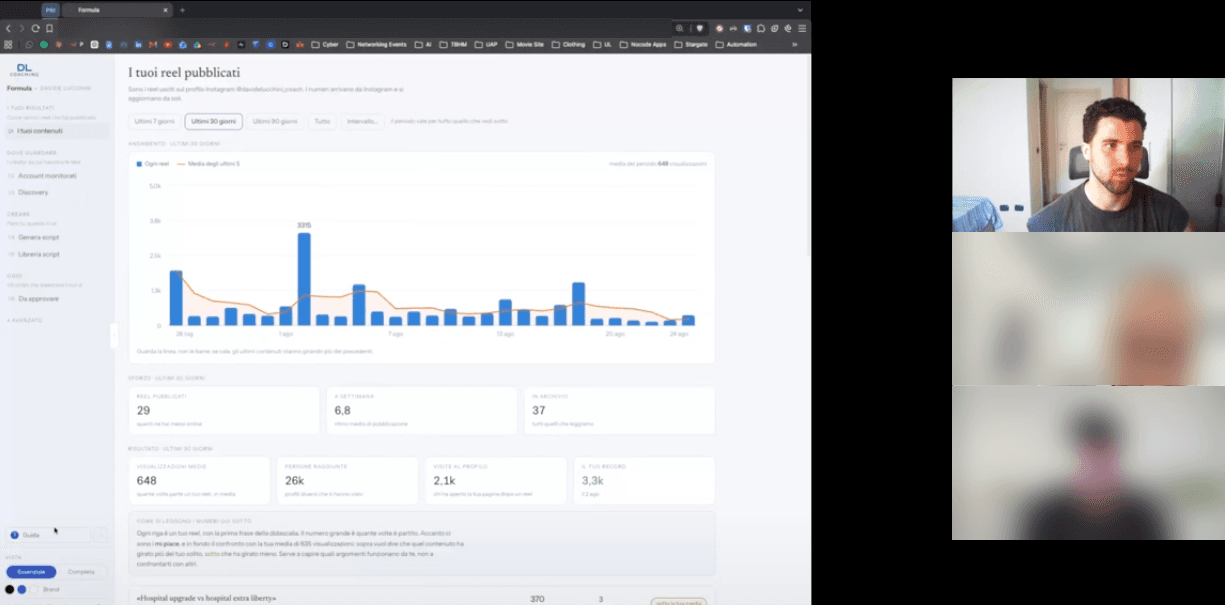
Views alone tell you almost nothing.
The plan was to learn from people already doing well in his world. The trap is judging that by view count. A video with a million views that makes nobody do anything is a bad one to copy.
So the tool looks at what people did after watching — did they comment, did they react — not just how many saw it. That is the part that separates a video that worked from a video that got lucky.
We also compare his videos against what his own account does now, not against everything he has ever posted. A hit from two years ago would set the bar so high that everything he films today looks like a failure. A scoreboard that only ever says "worse" tells you nothing.
It watches, it picks, it writes.
He opens it in a browser with a username and password. Here are the six things it does.
- 01
It watches the right people
He names the accounts worth learning from. The tool collects their short videos — the ones that actually reach new people — and keeps an eye on them from then on.
- 02
It keeps only what worked
Anything that barely got seen is dropped. What is left is put in order by what people did after watching. He sees a short list instead of a feed.
- 03
It writes the script
He types the idea he wants to talk about. The tool takes the shape of a video that worked and writes his idea into it, three different ways. He reads the three and picks the one that sounds like him.
- 04
It shows him how he did
His own numbers, explained in plain words on the page rather than left as a chart to interpret. Each published video is linked back to the script it came from, so he can see which scripts are worth repeating.
- 05
His corrections stick
When he rewrites a line, he can tell the tool to remember it. The next script starts from the corrected version. Nothing he wrote before is thrown away.
- 06
His editor sees less
Whoever edits the videos gets a simpler version with just the two screens they need. They mark a video as published, and it reconnects to its script on its own.
His own site, and room for a second coach.
It runs at his own address, on a server set up for him. Updates go out without the site ever going down: the new version is built alongside the old one and only swapped in once it is ready.
One decision was made on day one that nobody asked for. Nothing in it is named after Davide. A second coaching business could be added tomorrow without rebuilding it — because that is the version of this worth owning.
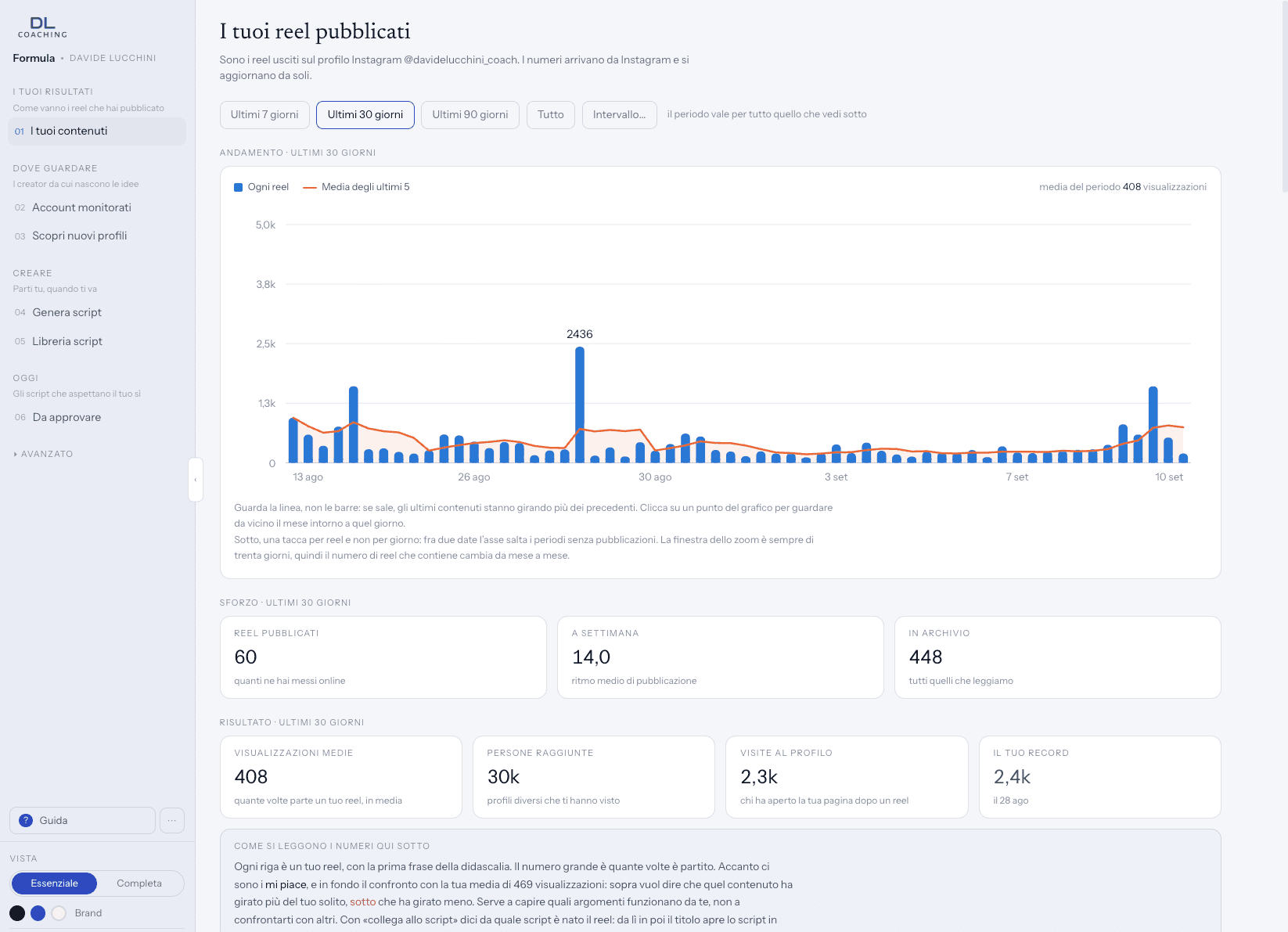
The blank page is gone.
He opens the tool, picks an idea, reads three versions, films one. The numbers below are what came out of the first thirty days.
The webinar had its audience. The tool that built it is still running.
Read off the live tool, September 2026.
He stopped guessing what to post.