On a changeover Saturday, nobody knew which rooms were ready.
Salinello is a holiday village on the Adriatic coast with 450 units. On peak weekends more than a hundred of them turn over in a day. Reception was finding out a room was clean by walking to it, or by asking on the radio. We built the system that tells them instead.
- Sector
- Hospitality · holiday village
- Built as
- CTO, Prisma Group
- Shipped
- July 2026 · live for the season
- Scale
- 450 units, 120+ turned on a peak day
- Their site
- salinello.it
The information existed. It was just in people's heads.
Somebody always knew whether a room was ready. The cleaner who had just finished it knew. The problem was that reception, standing at the desk with a guest in front of them, did not — and the only ways to find out were a radio call or a walk.
On an ordinary Tuesday that is a small friction. On a changeover Saturday with a hundred and twenty units turning, it is the whole day. Guests arrive early, priorities shift, an accessible unit needs to jump the queue, and the person who has to make those calls is working from a mental picture that was accurate twenty minutes ago.
The arrivals themselves came in as a spreadsheet each week. Reading it, turning it into a cleaning order, and keeping that order current as reality diverged from it was somebody's morning, every morning.
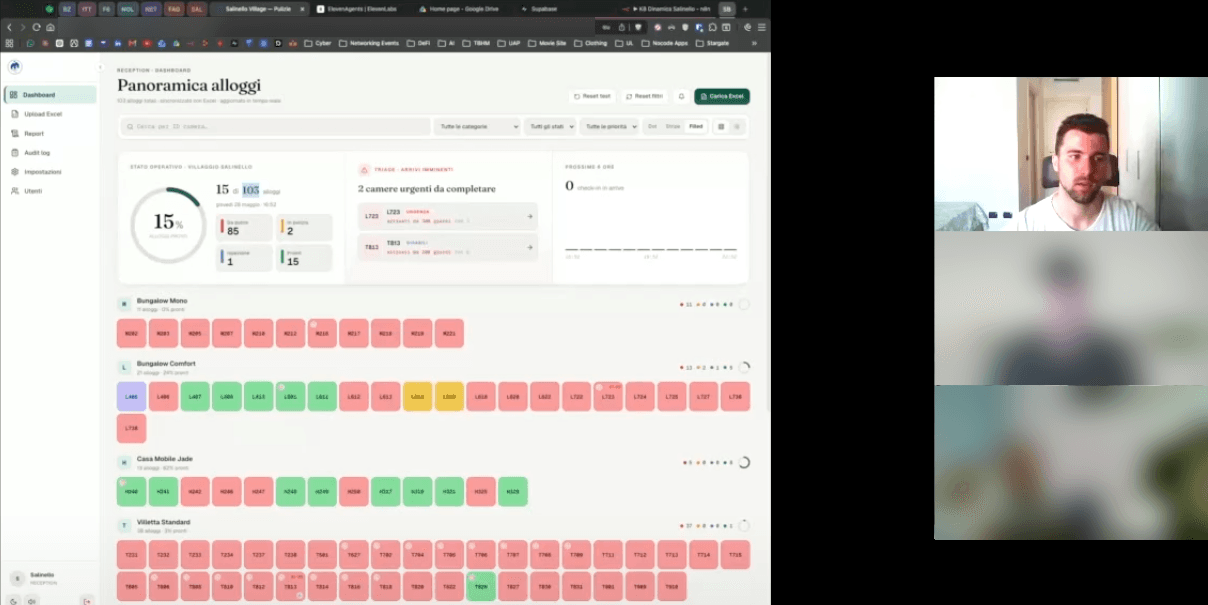
Two people, two completely different screens.
Reception and the cleaning crew need opposite things, and one screen serving both would have failed both.
Reception needs the whole village at a glance and needs to be interrupted: what percentage is ready, what is urgent right now, what is arriving in the next six hours. The crew needs the opposite — today only, one room at a time, in the order to do them, on a tablet, with the buttons big enough for someone holding cleaning supplies.
The other finding was about the exception, not the routine. The routine is easy. What breaks a plan is the guest who turns up four hours early and wants to go in. That case had to be a single button, not a re-plan: press it, and the room drops back to dirty and jumps the queue to just under the accessible and urgent ones.
And one thing we chose not to build. The arrivals stay a spreadsheet upload. It was tempting to integrate with the booking system, but the spreadsheet is a step reception already knows and already controls, and taking it away would have made the system feel like it was happening to them.
From the arrivals file to the guest walking in.
Four moments, in order, with the system carrying the state between them.
- 01
The week's arrivals
Reception uploads the arrivals spreadsheet. The system reads units, guests, times and priorities out of it and builds the day.
- 02
The crew's tablet
The supervisor sees today's units, sorted by urgency — accessible first, then urgent, then imminent arrivals, then everything else — and walks each one through: to clean, cleaning, inspection, ready. Notes on the unit carry the specifics, like a cot to set up.
- 03
Reception, live
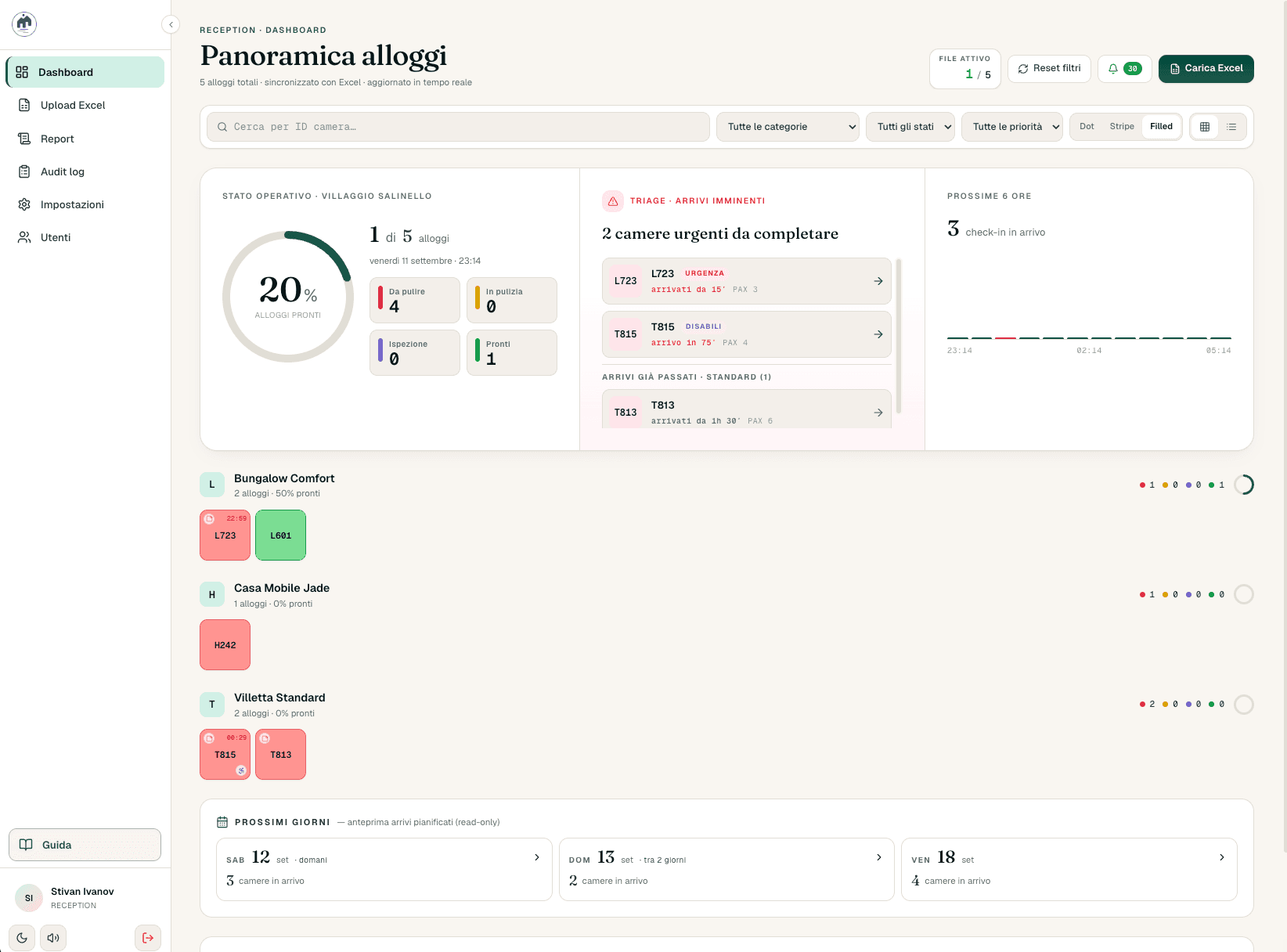
Every unit marked ready reaches reception with a sound. A ring shows the percentage ready, a red triage panel shows what needs attention now, and the next six hours of check-ins sit alongside it.
- 04
Early arrival
One button on the unit's card. It returns to dirty and rises to the top of the crew's list, under accessible and urgent. No re-planning, no phone call.
- 05
The voice agent
A separate line of the same system: an AI agent that answers guests' questions with the village's own information, so reception is not repeating opening hours all day.
- 06
The things it does at night
The agent's knowledge is refreshed from the village's own pages at 03:00. Reports snapshot at 12:00, 14:00 and 16:00. The day archives itself at 23:50. Automations back themselves up at 04:00. Nobody has to remember any of it.
Two views, one truth underneath.
Reception opens gestione.salinello.it and sees the village. The crew opens the same address on a tablet and sees today. Both read the same database, so there is no version of the day that disagrees with another version of the day.
The webapp carries its own guide and a walkthrough that takes a new person screen by screen, which matters in a business that rehires a crew every season. Reports cover the day and the month by unit category.
The running cost is about ten euro a month for the server and around twenty for the voice agent. The database sits inside a free tier. That was a design constraint, not an accident: a seasonal business should not inherit a subscription it resents in February.
Reception stopped walking.
A room finishes, a bell sounds at the desk, the percentage moves. The guest who arrived early gets handled with one press instead of a conversation. The day closes itself at ten to midnight.
Every account is in the village's name. The server, the database, the voice agent — all theirs, with the passwords handed over.
Handover documentation, 22 July 2026.
The knowledge was always in the building. Now it is on the desk.