Their designers spent days on the first sketch. Now it takes minutes.
FAG makes cardboard displays and packaging for supermarket chains and retail. Every job starts from a brief that arrives as an email, a paragraph, a photo, sometimes a pencil sketch. We built the platform that turns any of those into photorealistic concepts the sales team can carry into the meeting.
- Sector
- Packaging and cardboard displays
- Built as
- CTO, Prisma Group
- Shipped
- March 2026 · in production since
- Build window
- 11 weeks
- Their site
- fagartigrafiche.com
Nobody could say what the thing would look like.
A brief for a cardboard display arrives with almost nothing fixed. A client writes two lines about a Christmas promotion for a bakery chain, attaches a photo of a competitor's display, and waits. Somebody at FAG then has to imagine the object, hunt for references, sketch it, and only much later does anyone see a picture.
That gap was the expensive part. Not the drawing itself, but the days between the brief landing and the first image that the client could react to. Every one of those days was a day the client could drift, change their mind, or ask a competitor.
There was a second cost nobody had priced. FAG had decades of finished projects sitting on an internal server — thousands of images of displays they had already built and already knew how to produce. In practice it was unusable, because finding anything meant remembering it existed first.
Two jobs were fighting each other inside one tool.
The first sessions made something obvious. Exploring ideas and specifying a producible object are opposite activities, and every attempt to serve both at once had produced a tool that was bad at each.
Exploration wants loose constraints: show me more, show me weirder, show me what a competitor did. Specification wants hard ones: 60 by 40 centimetres, three shelves, corrugated board, this is what our machines can actually cut.
So we split the product in two. An inspiration side with soft limits, and a configurator that converges step by step onto something the factory can make. You can start in either, and carry work from one to the other.
We also found the model had a blind spot worth designing around. Image models do not understand millimetres — tell one "420 mm wide" and it invents a proportion. So sizes became presets, each mapped to a reference image that shows the model what that size looks like. The number is for the human; the picture is for the machine.
Six stages, each usable on its own.
The platform is not one long wizard. It is six stages you run in sequence on a new job, or reach into individually when you only need one piece.
- 01
Inspiration
Search four sources at once — FAG's own archive, Google Images, Pinterest, and fresh AI generation — plus upload of hand sketches. Keep the good ones as a mood board you can reuse on any future job.
- 02
Configurator
Six guided steps: project and client, structure and size, which inspiration to lean on, products on the shelves, style and brand colours, review. It saves itself at every step, so an interrupted job resumes exactly where it stopped.
- 03
Generation
Three photorealistic views — front, flat front, front at 45 degrees — in three to eight minutes depending on the model chosen. The work runs in a queue, so the browser stays usable while it thinks.
- 04
Iteration
Duplicate and modify restarts from the same inputs without re-entering anything. Modify retouches an image already produced while holding the shape it had. Both keep the full history.
- 05
Searchable archive
Everything on their old picture server is copied across and looked at by an AI, which writes down what is actually in each image. After that you search it the way you would ask a colleague — "the Christmas display we did for a bakery" — instead of guessing at file names.
- 06
Die-line mockups
The client's print die-line is projected onto the faces of a calibrated blank. No AI anywhere in this step: it is geometry, so the same file produces the same result every single time, with the artwork exactly where it belongs.
One address, no install, three ways in.
It lives at gen.fagartigrafiche.com and opens in any browser. Staff sign in with their company Microsoft account, or with email and password, or with a link sent to their inbox — FAG picked which of the three to push, we shipped all of them.
Underneath, the heavy work happens in a queue rather than while you wait, so the page stays usable while the AI thinks. Three different image models are connected, and every picture records which one drew it, so nobody has to guess later.
Security was not an afterthought here. FAG had been attacked before, so the build carried isolation, encryption at rest, audit logging, and a security review as fixed requirements rather than nice-to-haves.
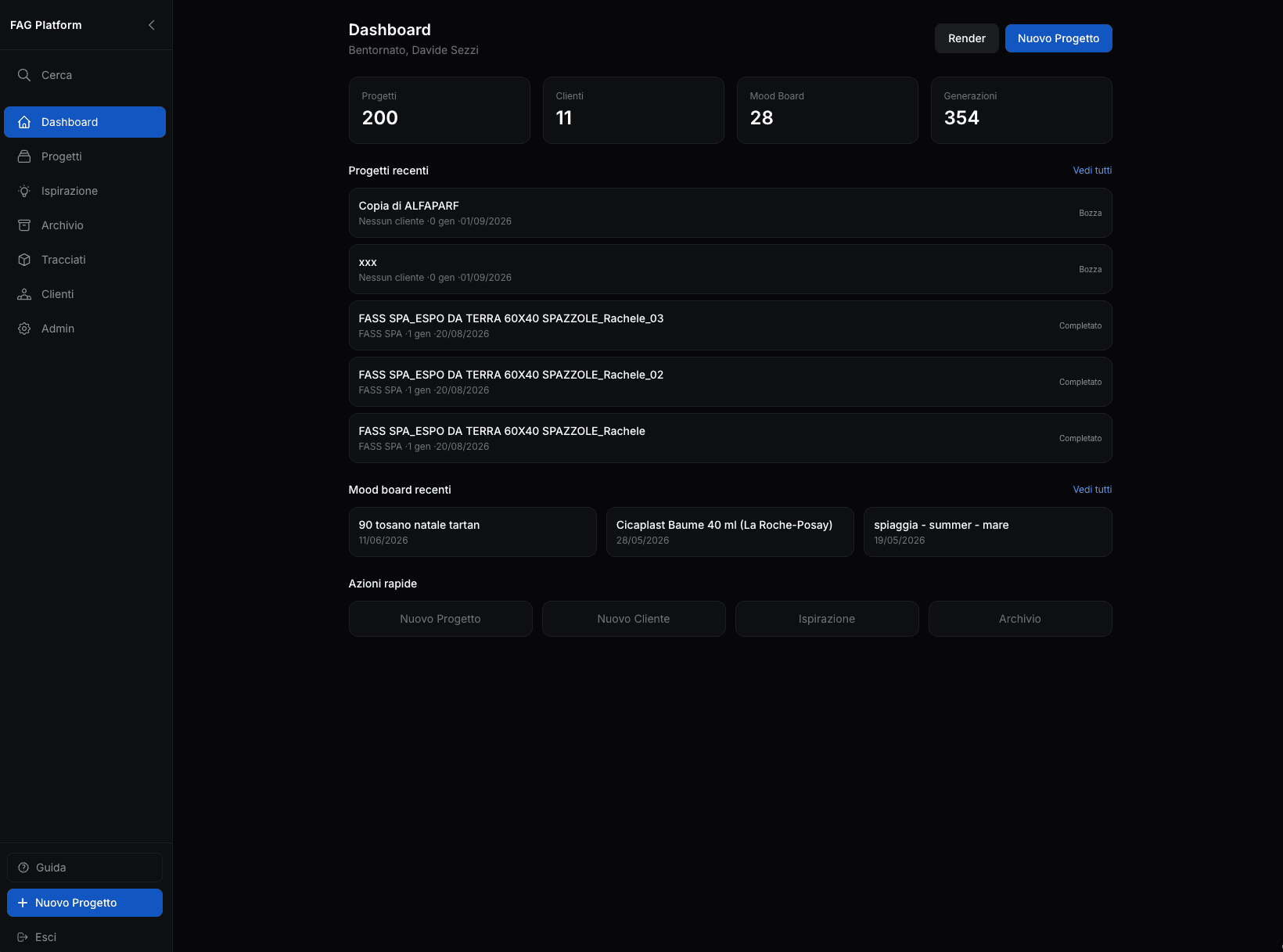
Four months of production, read off the database.
The numbers below were read from the production database on 27 July 2026, at handover. Nothing here is a projection.
The whole system — server, database, domain, the AI accounts, the source code — was handed to FAG with the passwords. It runs on their infrastructure, billed to them, with no dependency on us to keep the lights on.
Production database, read 27 July 2026.
FAG's designers did not get replaced. They got the first three hours of every job back.