The answer was always in a document. Finding it was the problem.
ABTG is Italy's largest financial education group. Their institutional knowledge lived in a Drive full of documents that were genuinely good and practically unsearchable, so people asked colleagues instead. We built an assistant that answers from those documents, inside the chat the company already uses all day.
- Sector
- Financial education and training
- Built as
- CTO, Prisma Group
- Shipped
- 2026 · in production
- Lives in
- Google Chat — no new app
- Their site
- alfiobardolla.com
Asking a colleague was faster than searching.
That sentence is the whole diagnosis. When looking something up is slower than interrupting somebody who knows, people interrupt, and the cost lands on whoever is most knowledgeable — quietly, constantly, and without anyone measuring it.
The documents were not the problem. There were plenty of them and they were correct. Drive search finds filenames and exact words, and almost nobody asks a question in the words the document used.
Adoption was the hard part, not retrieval.
Internal tools fail by not being opened. A brilliant assistant on its own web address gets used enthusiastically for two weeks and then forgotten, because using it means remembering it exists and leaving whatever you were doing.
So the assistant does not have an address. It answers in Google Chat, where the team already is. There is nothing to log into, nothing to bookmark, and nothing to learn — you ask in the window that is already open.
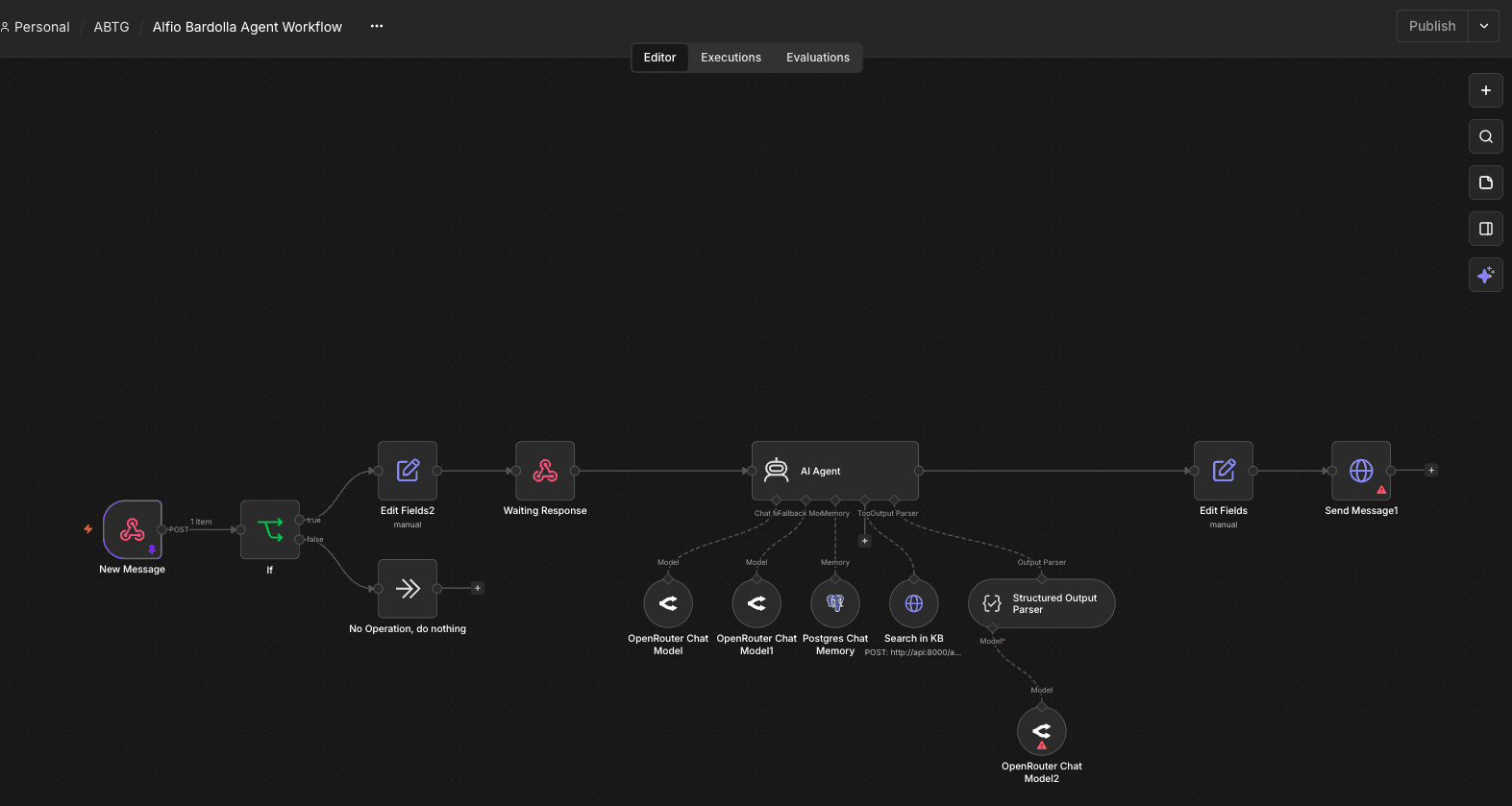
On the retrieval side we found one style of search was not enough. Meaning-based search handles a question asked in someone's own words but drifts on exact terms — a specific product name, a regulation. Keyword search does the reverse. So both run together and a second model reorders the combined results before anything is written. The answer itself is generated in Italian, from the retrieved passages.
Small, and it looks after itself.
Small on purpose. An internal tool that needs looking after is an internal tool that gets switched off.
- 01
It syncs itself
A background worker watches the Drive knowledge base and re-ingests what changes. Adding knowledge means putting a document where documents already go.
- 02
Two searches, then a re-rank
One search understands what you meant, the other matches the exact words you used. Both run, then a third step puts the combined results in the right order. Only the best few are used to write the answer.
- 03
Caching where it pays
Answers are remembered. If two people ask the same thing in the same week, it is only paid for once.
- 04
It answers in the chat
Someone asks in Google Chat, the answer comes back in the same conversation. Anything else that ever needs to ask it can be plugged in later.
- 05
Updating it is one step
It rebuilds and restarts itself on the server, and renews its own security certificate.
Boring to run, which is the point.
It sits on a server we set up, answers in Italian, and needs no looking after. Administrator accounts are protected with two-step login.
The measure of success here was never a dashboard. It was whether people stopped asking each other.
Production system, 2026.
The knowledge was never missing. It just needed somewhere to be asked.